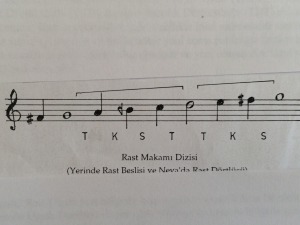
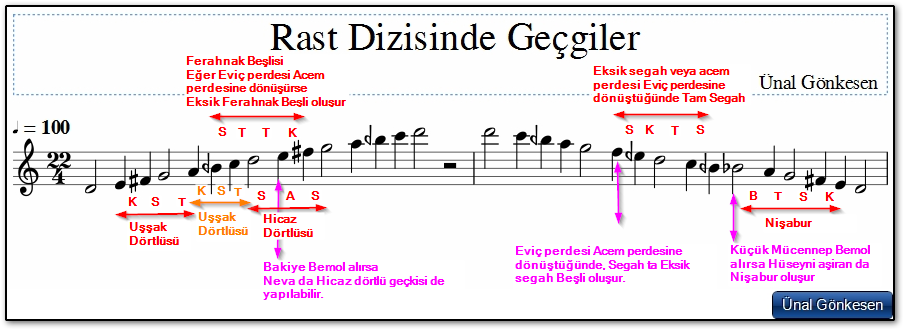
Rast is the implementation of the Rast scale in Turkish makam music. It is in 53 Tone Equal Temperament.
Rauf Yekta Bey's model places the Rast Makam as the gamme naturale of Turkish Classical Music and centers the theoretical approach around it. In the Arel Ezgi Uzdilek system, the scale centered in the theory became Çârgâh.
Rast in 53-TET
The Rast makam also has a Rast tetrachord extension in its lower registers, that is octave equivalent to the second çeşni in Rast ascending. The notes are: Yegâh, Hüseyni-Aşiran, Irak, ending with Rast.
Comparison with Western scales
Since the makam is based on 53-TET, it is impossible to directly tie it to 12-TET Western scales. However, using the 48-TET model, while worse than many other models in approximation, allows for such comparisons.
The approximation of Rast ascending within 48-TET would be:
- Major (3, 7)
While Rast descending would be:
- Mixolydian (3)
Usage and understanding of Rast
Emotional effects of Rast
The Rast makam is understood to make listeners feel positive feelings, such as the following: Joy, relief, calmness, confidence, serenity and a sense of security.
Religious usage
Rast is one of the most prevalent makams used in reciting the Quran. It's also used during the ezan (daily call to prayer).
Songs that use the Rast scale
- Yine Bir Gülnihâl
- Açılan Bir Gül Gibi
Related makams
- Acemli Rast (Rast with Acem), same as Rast descending
Notes
References
See also
- Rast pitch class set